What’s New in Ansible Automation Controller 4.0
Ansible Automation Platform 2.0 is the next evolution in automation from Red Hat’s trusted enterprise technology experts. We are excited to announce that the Ansible Automation Platform 2.0 release includes automation controller 4.0, the improved and renamed Ansible Tower.
Controller continues to provide a standardized way to define, operate, and delegate automation across the enterprise. It also introduces new, exciting technologies and an enhanced architecture that enables automation teams to scale and deliver automation rapidly to meet ever-growing business demand.
Why was Ansible Tower renamed to Automation controller?
As Ansible Automation Platform 2.0 continues to evolve, certain functionality has been decoupled (and will continue to be decoupled in 2.1) from what was formerly known as Ansible Tower. It made sense to introduce the naming change that better reflects these enhancements and the overall position within the Ansible Automation Platform suite.
Who uses Automation controller?
All automation team members interact with or rely on automation controller, either directly or indirectly.
- Automation creators develop Ansible playbooks, roles, and modules.
- Automation architects elevate automation across teams to align with IT processes and streamline adoption.
- Automation operators ensure the automation platform and framework are operational.
These roles are not necessarily dedicated to a person or team. Many organizations assign multiple roles to people or outsource specific automation tasks based on their needs.
Automation operators are typically the primary individuals who interact directly with the automation controller, based on their responsibilities.
This blog highlights automation controller’s improved architecture, enhancements, and how these benefit you.
An improved architecture
Automation controller’s improved distributed architecture enables automation operators to deploy instances over diverse platforms and scale automation rapidly to meet growing volume demands.
Let’s compare the previous Tower architecture to the updated controller architecture.
Previous Ansible Tower 3.8 architecture

Rigid and tightly coupled
*Automation teams need to deliver outcomes autonomously and, at other times, in coordination and collaboration.*
The Ansible Tower architecture tightly couples the control and execution plane, which can increase overhead and inefficiencies when scaling to meet high demand.
For example, let’s imagine the networking team creates new automation content that relies on the netaddr 0.7.20 Python package. The security team, however, has developed their automation using a later version of netaddr. Both teams need a unique netaddr version to execute their automation successfully.
Automation operators spend significant time ensuring the different versions of netaddr are available and kept consistent across Ansible Automation Platform instances or jointly manage these dependencies with these teams.
Imagine how the overhead required to ensure consistent execution multiplies as more teams join, deployed instances increase, and automation content expands.
Inconsistent execution
*Automation teams need to ensure automation content executes consistently across the enterprise.*
Operators need ancillary tools to deploy and manage dependencies across separate Ansible Automation Platform instances for consistent automation execution. These dependencies can include Python packages, Python versions, frameworks, and Ansible content.
Ansible Tower uses Python virtual environments to manage dependencies, but this method introduces challenges.
- Managing Python virtual environments across multiple Ansible Tower instances slows development cycles as additional effort is needed to prevent inconsistent non-production and production systems.
- Ensuring custom dependencies are consistent across Ansible Tower instances grows in complexity as you increase deployments and as more users interact with it.
- Python virtual environments are challenging to port across Ansible Tower instances and tightly coupled to the control plane.
- There are no tools supported and maintained by Red Hat to manage custom dependencies across Ansible Automation Platform deployments.
We’ve listened to and acknowledged your feedback. Scaling your automation was difficult. In response, we’ve introduced an improved, distributed architecture.
The new, improved Automation controller 4.0 architecture
Automate for growth
*Automation teams need to provide automation where and when the business needs it rapidly.*
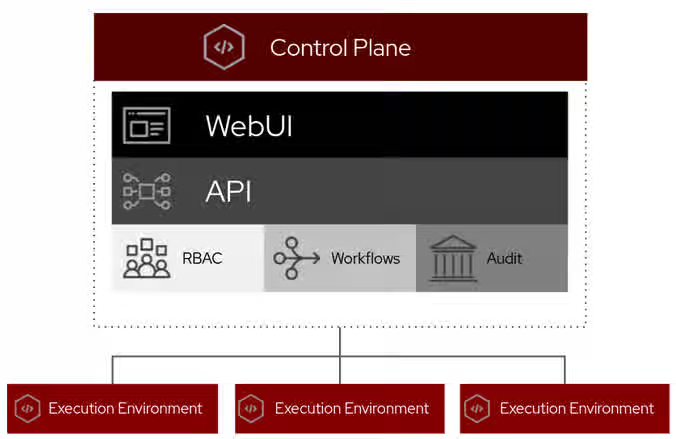
Controller introduces a distributed, modular architecture with a decoupled control and execution plane. It enables teams to scale and deliver automation with reduced overhead and increased velocity.
Execution environments
*Portability is reliability.*
Ansible Automation Platform 2.0 introduces automation execution environments. Execution environments are self-contained images in which all automation runs, containing Ansible, Ansible content, and any additional dependencies.
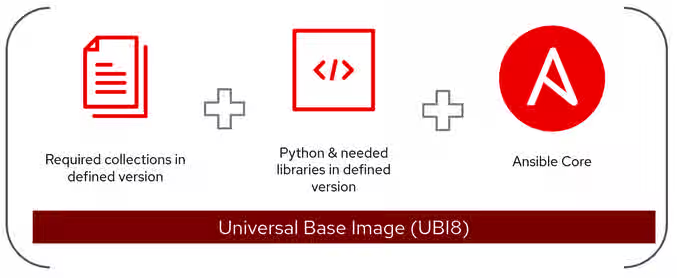
Using execution environments, you ensure that automation runs consistently across multiple platforms. All custom dependencies are defined at the development phase and are no longer tightly coupled to the control plane resulting in faster development cycles, scalability, reliability, and portability across environments.
For more insight into automation execution environments, please refer to this blog written by Anshul Behl.
PostgreSQL 12
Ansible Automation Platform 2.0 ships with PostgreSQL 12 installed from Red Hat Enterprise Linux 8 modules by default.
PostgreSQL 12 introduces a host of significant improvements. Most notably, Ansible Automation Platform 2.0 uses partitioned access for increased performance.
Automation controller installation
*Automation teams need a single automation solution that spans the hybrid cloud.*
Ansible Automation Platform 2.0 continues to provide a familiar installation experience across physical, virtual, and containerized environments.
Automation platform operator
Ansible Automation Platform 2.0 introduces the Automation platform operator, which provides a cloud-native, push-button deployment of new Ansible Automation Platform instances in your OpenShift environment. It simplifies data management, migration, and platform upgrades.
Additionally, the resource operator makes it easier to integrate automation into your cloud-native processes.
Please visit the Ansible Automation Platform 2.0 Early Access Homepage for more information.
User interface experience
*Automation controller’s user interface features a host of improvements while providing a familiar experience easing migrations and the adoption of Ansible Automation Platform 2.0.*
PatternFly 4
The interface uses PatternFly 4 framework. This change provides increased performance and consistency with other Ansible Automation Platform 2.0 components and Red Hat offerings.
Improved observability, interaction, and security
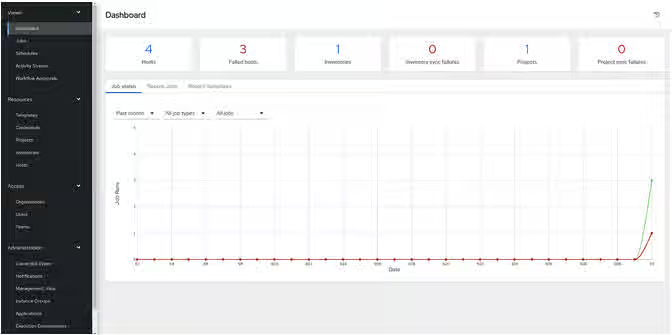
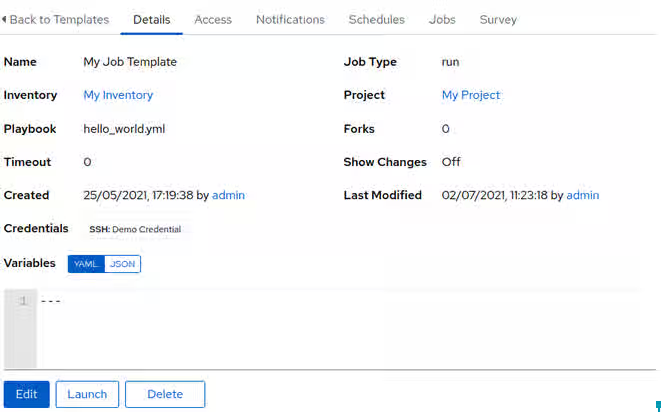
The improved interface introduces distinct ‘view’ and ‘edit’ perspectives for automation controller objects and components — a frequently requested capability based on your feedback.
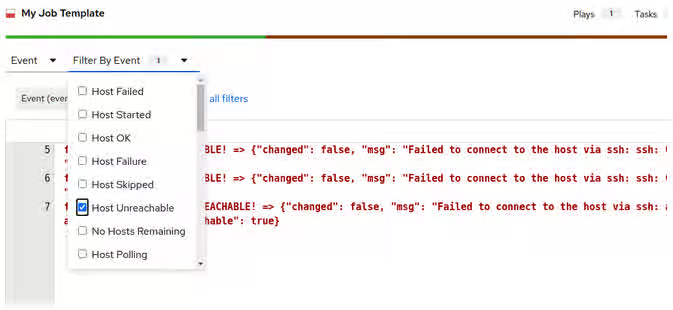
Controller also provides intuitive filters that automation operators can use to display concise information relevant to the task at hand.
The automation operator filters the controller 4.0 Job output to display 'Host Unreachable' events in the example below. This makes it easier to identify and remediate the errors.
Content Security Policy
Controller’s interface redesign includes a strict Content Security Policy adding an additional layer of protection that detects and mitigates common cybersecurity threats.
Additional enhancements
Automation controller 4.0 introduces improvements throughout the platform, including the browsable API, role-based access control, job scheduling, integrated notifications, graphical inventory management, and workflow visualizer functions.
Here are several enhancements not covered in this blog:
- Controller leverages Python 3.8
- Nginx has been updated to version 1.18 and uses RHEL 8 cryptography profiles.
- Automation operators can disable the ability to add local users to controller 4.0 and only allow authentication via a configured identity provider.
- Controller 4.0 provides new Prometheus metrics for tracking and debugging job event performance.
- An additional
awx-managesubcommand allows operators to extract host automation details. - GitHub Enterprise is a supported identity provider.
Please review the Content from docs.ansible.com is not included.controller release notes for more information on all the changes automation controller 4.0 introduces.
Migration considerations
Ansible Automation Platform 2.0 provides exciting new capabilities. These changes, however, also bring new requirements and dependencies that need careful consideration before migrating to Ansible Automation Platform 2.0. Please visit the Ansible Automation Platform 2.0 Early Access Homepage for more information.
Below are some key considerations related to the topics covered in this blog. Please review all the requirements on the “Automation controller install page.”
Will Ansible Automation Platform 2.0 support Isolated nodes?
Ansible Automation Platform 2.0 does not support isolated nodes. The Ansible Automation Platform 2.1 roadmap includes this functionality and is planned for release in November 2021.
Does Ansible Automation Platform 2.0 support previous PostgreSQL versions?
No. PostgreSQL 12 is currently the only supported database for Ansible Automation Platform 2.0. Please keep this in mind as you develop your organization’s migration plan.
Do I need OpenShift to run execution environments?
No. It is key to our mission that Ansible Automation Platform supports all Red Hat platforms. Ansible Automation Platform 2.0 can be deployed on Red Hat Enterprise Linux (x86_64), OpenShift, or a combination of both to suit your needs - in the data center, cloud, or at the edge.
What operating systems are supported for Ansible Automation Platform 2.0 installation?
Ansible Automation Platform 2.0 supports Red Hat Enterprise Linux 8.3 (x86_64) or later for installation on physical or virtual environments.
Key takeaways
*Many organizations do not realize the full potential of automation because they aren’t able to scale.*
Automation volume demand is increasing as IT systems continue to evolve and automation adoption grows. Controller 4.0 features new capabilities focussed on empowering automation teams to scale and satisfy this demand.
Our goal is to simplify your Ansible Automation Platform 2.0 migration and adoption. As we introduce controller 4.0 and its capabilities, we provide the familiar experience automation teams are accustomed to and continue to support multiple installation platforms - physical, virtual, and containerized.
Controller’s new architecture, leveraging execution environments, simplifies dependency management, improves reliability, consistency and accelerates delivery across Ansible Automation Platform instances.
Controller’s upgraded user interface provides better security, performance and improves observability with new filtering capabilities and distinct views.
Automation Platform Operator provides cloud-native deployment and management of your Ansible Automation Platform 2.0 instances on Red Hat OpenShift. Additionally, the resource operator simplifies integrating automation with your cloud-native processes.
Please visit the Ansible Automation Platform 2.0 Early Access Homepage for more information on controller 4.0.
The Ansible Automation Platform 2.0 release, which includes automation controller 4.0, introduces a host of new, exciting technologies and improves the familiar experience for automation teams, business decision-makers, and end-users alike.
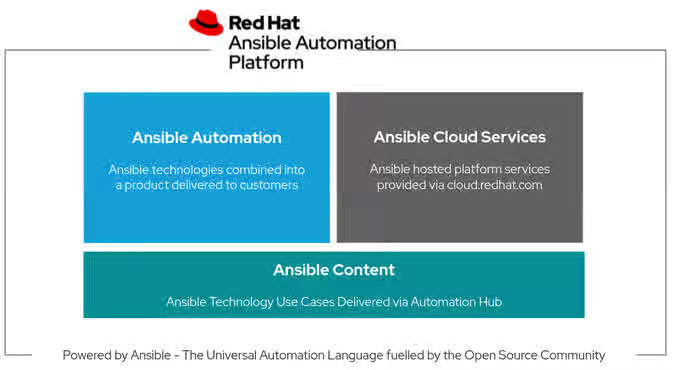
Please visit the Content from docs.ansible.com is not included.Ansible Automation Platform Docs page for more information on how it adapts to maturing business needs and provides a unified solution focussed on acceleration, consistency, and collaboration.
Where to go next
- Ansible Automation Platform 2.0 Early Access Homepage provides a consolidated view of our documentation and guidance.
- Introducing Ansible Automation Platform 2.0 Early Access blog
- Please reach out to your local Red Hat representative to assist your organization in getting started with Ansible Automation Platform 2.0.