Red Hat OpenStack Services on OpenShift FAQ
What is Red Hat OpenStack Services on Openshift?
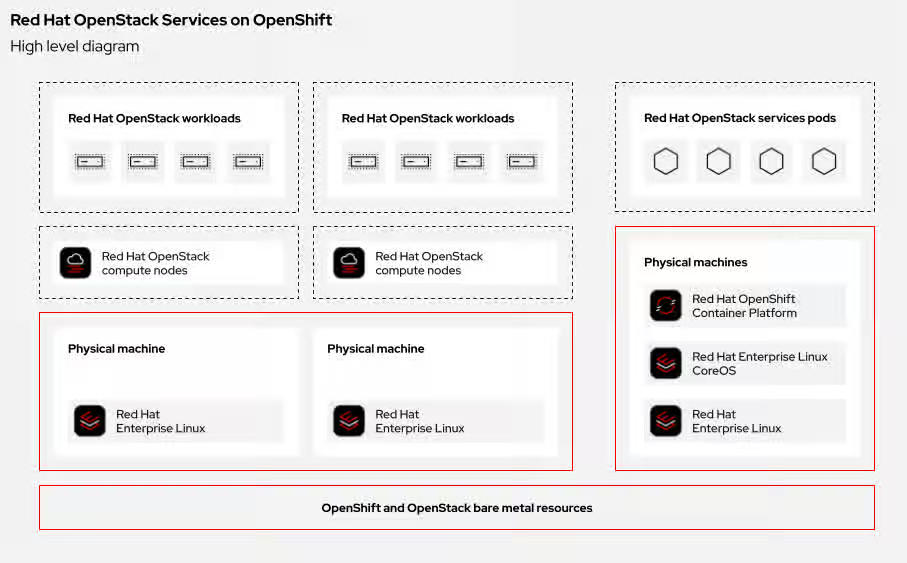
Red Hat OpenStack Services on OpenShift (RHOSO) is the next major release of Red Hat OpenStack Platform (RHOSP), which will be exclusively based on the next-generation form factor, with the control plane natively hosted on Red Hat OpenShift and the external Red Hat Enterprise Linux-based dataplane managed using Ansible.
This will enable customers to future-proof their existing investments by using Red Hat OpenShift as a hosting platform for all of their infrastructure services.
Is Red Hat OpenStack Platform going away or End-of-life?
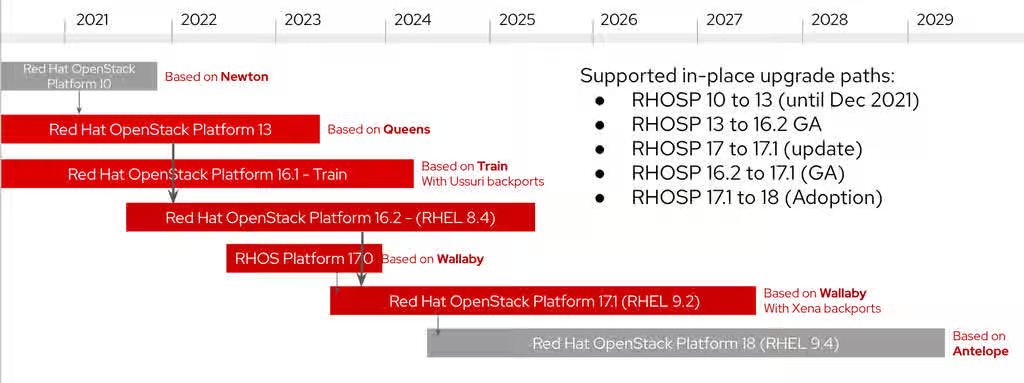
No, Red Hat OpenStack Platform lifecycle goes to late-2029. The release of Red Hat OpenStack Services on OpenShift will be the eighteenth version (following RHOSP 17.1). Per Content from www.stackalytics.io is not included.Stackalytics, Red Hat is the leading contributor to OpenStack based on commits and accounts for more than 25% of all contributions.
The RHOSP lifecycle allows customers to adopt RHOSO at their own pace by allowing three years of parallel lifecycle overlap with Red Hat OpenStack Platform 17.1.
How do I upgrade to Red Hat OpenStack Services on Openshift? Will upgrading to Red Hat OpenStack Services on Openshift disrupt my existing workloads?
Only customers running Red Hat OpenStack Platform 17.1 will be able to upgrade to Red Hat OpenStack Services on OpenShift.
The new upgrade strategy will be based on an adoption mechanism that allows workloads running on RHOSP 17.1 to be migrated as part of this transition.
Upgrading to RHOSO will not disrupt your existing workloads. The new control plane, hosted on OpenShift, will adopt and manage the existing dataplane running RHOSP 17.1 and upgrade it to the next version while workloads remain on the same computes.
The overlap provides customers sufficient validation time for lab and field trials and time for operation teams to ramp up on the OpenShift framework skill set.
I’m currently running Red Hat OpenStack Platform 16.2, can I use the adoption mechanism to upgrade to Red Hat OpenStack Services on Openshift?
No, you cannot directly upgrade to Red Hat OpenStack Services on OpenShift from Red Hat OpenStack Platform 16.2 using the adoption mechanism. An intermediate upgrade to RHOSP 17.1 is required first, followed by the RHOSP 17.1 to RHOSO adoption procedure.
Alternatively, you can engage with Red Hat services to plan a parallel cloud migration leveraging the updated Content from github.com is not included.os-migrate project.
Do I need to purchase Red Hat OpenShift to use Red Hat OpenStack Services on OpenShift?
You do not need to purchase Red Hat OpenShift in addition to Red Hat OpenStack Services on OpenShift. RHOSO will use dedicated SKUs for it’s control plane that include OpenShift worker nodes (up to 3 nodes).
The SKUs covering RHOSO are limited to the hosting OpenStack control plane and lifecycle tooling with the addition of other infrastructure-related Red Hat layered functions, for example; ACM, ACS, Observability, ODF, SSO, Quay, etc.
However, if you are interested in expanding the usage of the OpenShift infrastructure cluster to handle third party workloads (purchased or self built), additional OpenShift worker SKUs will be required. Please reach out to your account representative for more information.
What is unified observability?
Red Hat OpenStack Services on OpenShift can help customers gain a deeper understanding about the health of their hybrid cloud. In RHOSO, we are adding additional value to OpenStack Observability by unifying OpenStack and OpenShift Observability components to deliver a more complete Observability experience.
Some new features coming to the GA release of RHOSO:
- Observability UI: In RHOSO, the Observability UI experience will be utilizing the same UI components as the OpenShift Observability UI for a unified visualization experience.
- Metrics: RHOSO metrics will be collected via Cluster Observability Operator, which is the same Prometheus metrics collection as OpenShift.
- Logs: In RHOSO, users can collect logs from both the control and data planes using OpenShift Cluster Logging Operator and will be able to forward those logs to various enterprise endpoints, such as Splunk or Elastic search. If users want to store their logs locally, they can take advantage of the OpenShift Loki operator to store, search, and visualize logs in-cluster.
What unified management capabilities can customers expect?
By integrating Kubernetes with OpenStack, organizations see improved resource management and scalability, unified management across the hybrid cloud, simplified development, and DevOps practices.
Red Hat OpenStack Services on OpenShift offers greater flexibility with the ability to run applications that are bare-metal, virtualized and containerized together - customers can run what’s best for their business, no matter where they are in their IT transformation journey.
Besides the single pane of glass we are creating with observability a good example could be baremetal resource management. Now that we are using metal3 inventory we can easily transition bare metal nodes from the OpenShift side to be used as OpenStack compute and vice versa if more resources are required for the hosting OpenShift cluster.
What is the support lifecycle?
The support life cycle for Red Hat OpenStack Services on OpenShift will be 5 Years (standard support plus extended life), similar to the previous Red Hat OpenStack Platform long-life releases.
By employing Red Hat Enterprise Linux 9.4 as the foundational operating system for compute nodes, RHOSO effectively decreases the complexity of upgrading from RHOSP 17.1 (which leverages RHEL 9.2) to RHOSO, necessitating fewer reboots during the process. In comparison to upgrading from RHOSP 16.2 to RHOSP 17.1, the adoption of RHOSO (from RHOSP 17.1) will take about a quarter of the time the former upgrade process took.
Additionally, the hosting OpenShift cluster will need to be updated to keep the setup fully supported, and only even (EUS) versions of OpenShift will be supported. Furthermore, Ceph, which is now totally external from the OpenStack deployment, will be verified and tested while adhering to its own lifecycle and will need to be updated accordingly.
RHOSO introduces a new lifecycle model with feature releases. Periodic releases will not only incorporate fixes from all types of releases (CVEs, Bugs, Grades), but also allow for feature backports and RFEs. Within a feature update, tech preview features can move to full support. For more detailed information on the supported OpenShift and RHEL versions, see the Life Cycle Dates section on the Red Hat OpenStack Life Cycle page.
RHOSO's clear separation between its infrastructure (OpenShift), podified control plane, and RHEL-based dataplane means each area can be managed and updated without impacting the others.
What is the podified control plane?
The podified control plane is the OpenStack control plane services in Red Hat OpenStack Services on OpenShift now running in pods and deployed, updated and configured by their respective operators.
What if I am unfamiliar with Red Hat OpenShift or do not have the skillset?
Red Hat OpenStack Services on OpenShift is focused primarily on hosting OpenStack control plane services on OpenShift, so the learning curve for OpenShift capabilities is limited in scope.
Additionally, customers can leverage Red Hat training services for fast skill ramp up. To gain a comprehensive understanding of OpenShift, it's advised to complete the DO180 and DO280 training modules.
Can Red Hat OpenStack Services on Openshift replace my virtualization platform?
Red Hat OpenStack Services on OpenShift provides enterprise scale architecture for the delivery of Infrastructure-as-a-Service (IaaS) that enables customers to operate in a hybrid environment with containerized applications and virtual machine applications.
This offers a multi-tenancy infrastructure and host isolation for traditional virtual machines and new containerized applications while providing a seamless transition path to cloud-native platforms for customers ready to innovate with OpenShift. RHOSO can provide a large scale IaaS with heavy automation needs and specific security requirements including ANSSI and Fedramp.
Red Hat also offers a general-purpose virtualization offering, with This content is not included.Red Hat OpenShift Virtualization.
The OPENSTACK logo and word mark are trademarks or registered trademarks of OpenInfra Foundation, used under license.