Usage of Red Hat Unlimited Guest & VDC Subscriptions in Virtualized Clusters.
Authors
This content is not included.Rich Jerrido - Principal Technical Product Marketing Manager, Red Hat
Overview
As a user of Red Hat's Subscription Management Systems (Red Hat Subscription Management, Red Hat Satellite), you leverage subscriptions such as Red Hat Enterprise Linux with Unlimited Guests or Red Hat Enterprise Linux for Virtual Datacenters (VDC) on a hypervisor platform such as RHEV 3, RHV 4, VMWare or Hyper-v. These platforms allow the grouping of hypervisors for management reasons. You'd like to know if it is possible to use various forms of partitioning such as VMWare's DRS to limit which hypervisors that Red Hat workloads run on.
Note that only hypervisors running RHEL virtual machines require Red Hat Enterprise Linux with Unlimited Guests or Red Hat Enterprise Linux for Virtual Datacenters (VDC) subscriptions.
Solution
A customer can use a Content from pubs.vmware.com is not included.VM-Host Affinity Rule to further subdivide their virtualization clusters for the purposes of saving on subscription or licensing costs. VMWare provides the ability to set those affinity rules in two methodologies:
- required rules (designated by "must")
- preferential rules (designated by "should")
Red Hat recommends the usage of the required rule types as they provide greater assurance that virtual machines running Red Hat based workloads do not run on unintended hypervisors.
Requirements
- virt-who
- Red Hat Subscription Management (RHSM)
- If Red Hat Satellite is used, the version must be 6.0.x or newer
Notes
Customers can use affinity rules provided that the policies do not supersede Red Hat's business rules.
Example Use Case
In the examples below, we will be using the following image:
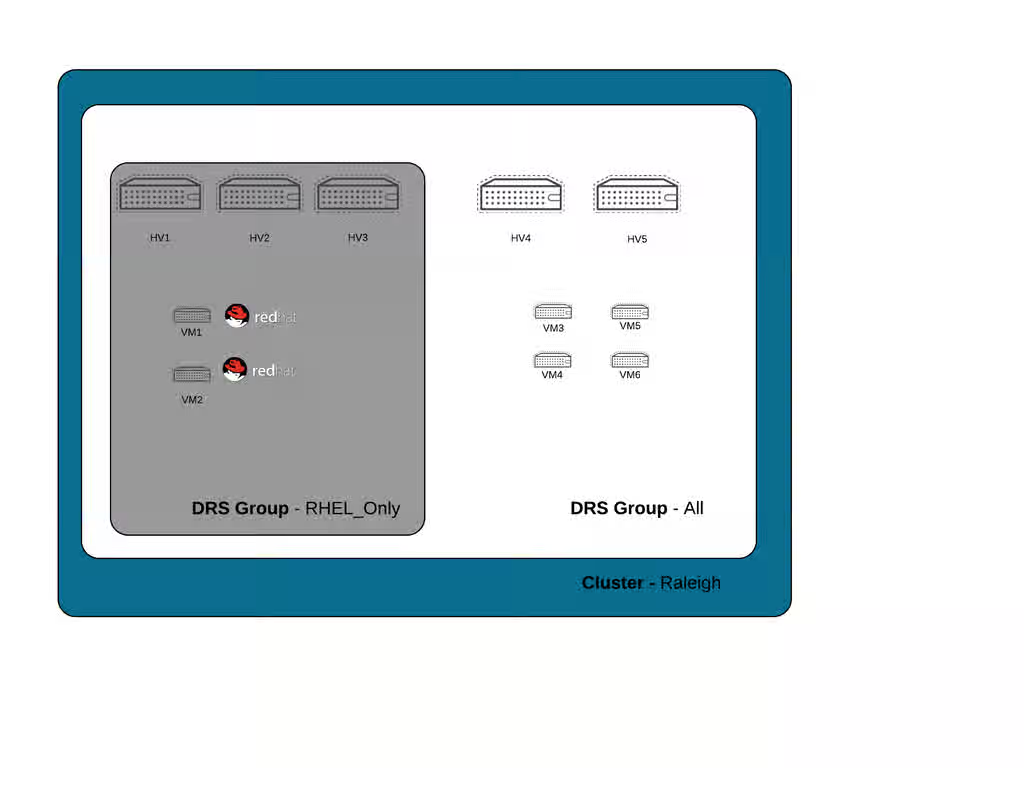
This example includes:
- One virtualization cluster Raleigh
- Five (5) hypervisors, named HV1 through HV5
- Six (6) virtual machines, named VM1 through VM6
- Two (2) of these virtual machines (VM1 & VM2) run Red Hat workloads.
- Four (4) of these virtual machines (VM3 through VM6) do not.
- Two host DRS Groups:
- RHEL_Only - Containing only hypervisors HV1 through HV3
- All - Containing all the hypervisors (HV1 through HV5)
In this example, Quantity Three (3) of an unlimited-type subscription, such as RH00001 Red Hat Enterprise Linux for Virtual Datacenters, Premium, would be purchased to properly subscribe the hypervisors (HV1 through HV3), which do run Red Hat workloads.
Expected Behavior of Red Hat's subscription tools.
To properly leverage Red Hat Enterprise Linux with Unlimited Guests or Red Hat Enterprise Linux for Virtual Datacenters subscriptions, it is expected that virt-who is properly configured. If you choose to use DRS rules of the preferential type, workloads may move to hypervisors where you do not wish them to run, and be advised that our subscription tools will attempt to ensure that the systems has a valid subscription. This will be seen as additional subscriptions (either vDC or instance based) being consumed. See the example below.
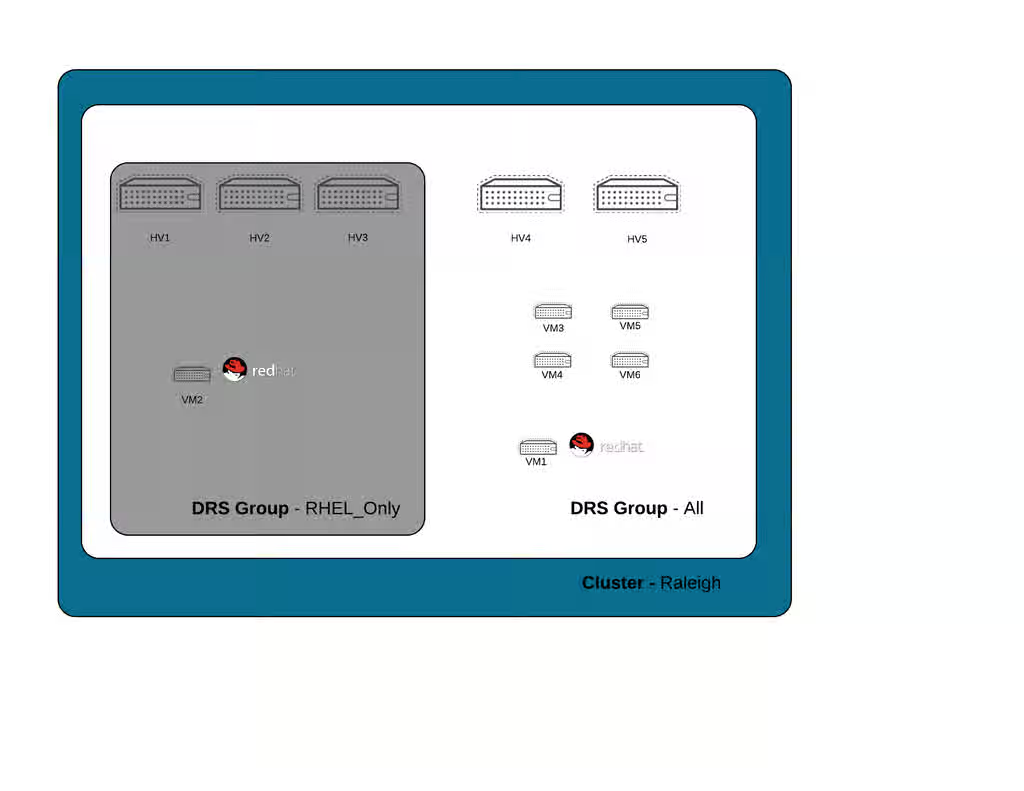
In this example, VM1 is migrated to HV4, which is on a hypervisor not in the RHEL_Only DRS Group. This migration can be initiated automatically or via an administrator. One of the following behaviors will occur post-migration
- If the hypervisor is known to the Subscription Management Platform, the virtual machine has been reported via virt-who, and an unlimited guest subscription is attached to the hypervisor (HV4), the guest will consume the virtual guest pool that already exists for the hypervisor.
- If the hypervisor is known to the Subscription Management Platform and the virtual machine has been reported via virt-who, but the hypervisor does not have a valid subscription, an unlimited guest subscription will get attached to the hypervisor (HV4) which will cover itself and the virtual machine (VM1)
- If the virtual machine VM1 has not been reported via virt-who, it will consume a physical subscription.
- If there are no additional subscriptions available, the system may not have a valid subscription, and may potentially lose access to content.
Additional Reading
Why and when do I need Virt-Who?
For more KB articles/solutions related to Virt-who and Virtual Datacenter (VDC) Subscriptions Issues, please refer to the Consolidated Troubleshooting Article for Virt-who and Virtual Datacenter (VDC) Subscriptions Issues