How do I access Red Hat Enterprise Linux 7 Extended Life Cycle Support (ELS) content after Red Hat Enterprise Linux 7 transitions to Extended Life Phase?
Issue
- How do I access Red Hat Enterprise Linux 7 Extended Life Cycle Support content after Red Hat Enterprise Linux 7 transitions to Extended Life Phase?
Environment
- Red Hat Enterprise Linux Server 7
- Red Hat Subscription Management
- Red Hat Satellite 6
- Red Hat Update Infrastructure
Resolution
Notice: The RHEL 7 ELS subscription and channels/repos will be available on July 1, 2024. This How-To article was published earlier to facilitate the configuration of servers using RHEL 7 ELS on or after July 1, 2024. This information is subject to change prior to the release of RHEL 7 ELS.
On June 30th, 2024, Red Hat Enterprise Linux 7 will transition from Maintenance Life Cycle 2 phase to Extended Life phase. You can read more about product life cycles here and the "FAQ: Red Hat Enterprise Linux 7 reaches End of Maintenance Phase and transitions to Extended Life Phase". At this time, Red Hat Enterprise Linux 7 content will continue to be accessible in the same way as it always has been via Red Hat Subscription Manager (RHSM), Red Hat Satellite 6, and Red Hat Update Infrastructure (RHUI)*.
If you have purchased the Red Hat Enterprise Linux Extended Life Cycle Support (ELS) Add-On offering, you will receive continued updates for Red Hat Enterprise Linux 7 via a new repository. Follow these steps to access Red Hat Enterprise Linux 7 Extended Life Cycle Support (ELS) content.
Quick Links
- Enabling Red Hat Enterprise Linux 7 ELS content with Satellite 6
- Enabling Red Hat Enterprise Linux 7 ELS content with Red Hat Update Infrastructure (RHUI)
- Connecting Red Hat Enterprise Linux 7 systems to ELS content
- Using RHEL 7 Container Images with Red Hat Enterprise Linux 7 Extended Life Cycle Repositories
Repository Label Conversion
x86_64 Architecture
| Non-ELS Label | ELS Label |
|---|---|
| rhel-7-server-rpms | rhel-7-server-els-rpms |
| rhel-7-server-debug-rpms | rhel-7-server-els-debug-rpms |
| rhel-7-server-source-rpms | rhel-7-server-els-source-rpms |
| rhel-7-server-isos | rhel-7-server-els-isos |
| rhel-ha-for-rhel-7-server-debug-rpms | rhel-ha-for-rhel-7-server-els-debug-rpms |
| rhel-ha-for-rhel-7-server-rpms | rhel-ha-for-rhel-7-server-els-rpms |
| rhel-ha-for-rhel-7-server-source-rpms | rhel-ha-for-rhel-7-server-els-source-rpms |
| rhel-rs-for-rhel-7-server-debug-rpms | rhel-rs-for-rhel-7-server-els-debug-rpms |
| rhel-rs-for-rhel-7-server-rpms | rhel-rs-for-rhel-7-server-els-rpms |
| rhel-rs-for-rhel-7-server-source-rpms | rhel-rs-for-rhel-7-server-els-source-rpms |
| rhel-sap-for-rhel-7-server-debug-rpms | rhel-sap-for-rhel-7-server-els-debug-rpms |
| rhel-sap-for-rhel-7-server-rpms | rhel-sap-for-rhel-7-server-els-rpms |
| rhel-sap-for-rhel-7-server-source-rpms | rhel-sap-for-rhel-7-server-els-source-rpms |
| rhel-7-server-optional-debug-rpms | rhel-7-server-els-optional-debug-rpms |
| rhel-7-server-optional-rpms | rhel-7-server-els-optional-rpms |
| rhel-7-server-optional-source-rpms | rhel-7-server-els-optional-source-rpms |
s390x Architecture
| Non-ELS Label | ELS Label |
|---|---|
| rhel-7-for-system-z-rpms | rhel-7-for-system-z-els-rpms |
| rhel-7-for-system-z-debug-rpms | rhel-7-for-system-z-els-debug-rpms |
| rhel-7-for-system-z-source-rpms | rhel-7-for-system-z-els-source-rpms |
| rhel-7-for-system-z-isos | rhel-7-for-system-z-els-isos |
| rhel-sap-for-rhel-7-for-system-z-debug-rpms | rhel-sap-for-rhel-7-for-system-z-els-debug-rpms |
| rhel-sap-for-rhel-7-for-system-z-rpms | rhel-sap-for-rhel-7-for-system-z-els-rpms |
| rhel-sap-for-rhel-7-for-system-z-source-rpms | rhel-sap-for-rhel-7-for-system-z-els-source-rpms |
| rhel-7-for-system-z-optional-debug-rpms | rhel-7-for-system-z-els-optional-debug-rpms |
| rhel-7-for-system-z-optional-rpms | rhel-7-for-system-z-els-optional-rpms |
| rhel-7-for-system-z-optional-source-rpms | rhel-7-for-system-z-els-optional-source-rpms |
RHUI Repositories (x86_64 arch only)
rhel-7-server-els-rhui-rpms
rhel-7-server-els-rhui-debug-rpms
rhel-7-server-els-rhui-source-rpms
rhel-7-server-els-optional-rhui-rpms
rhel-7-server-els-optional-rhui-debug-rpms
rhel-7-server-els-optional-rhui-source-rpms
rhel-ha-for-rhel-7-server-els-rhui-rpms
rhel-ha-for-rhel-7-server-els-rhui-debug-rpms
rhel-ha-for-rhel-7-server-els-rhui-source-rpms
rhel-rs-for-rhel-7-server-els-rhui-rpms
rhel-rs-for-rhel-7-server-els-rhui-debug-rpms
rhel-rs-for-rhel-7-server-els-rhui-source-rpms
rhel-sap-for-rhel-7-server-els-rhui-rpms
rhel-sap-for-rhel-7-server-els-rhui-debug-rpms
rhel-sap-for-rhel-7-server-els-rhui-source-rpms
rhel-sap-hana-for-rhel-7-server-els-rhui-rpms
rhel-sap-hana-for-rhel-7-server-els-rhui-debug-rpms
rhel-sap-hana-for-rhel-7-server-els-rhui-source-rpms
Note:
Can't find a repository label for your RHEL flavor or architecture? Please reach out to your sales representative.
Enabling Red Hat Enterprise Linux 7 Extended Life Cycle content with Satellite 6
In the case of Satellite 6, it is first required to add a subscription to your subscription manifest which provides access to the RHEL 7 ELS repositories. This may be performed from within the Satellite 6 webUI or via the Customer Portal.
Attach a RHEL Extended Life Cycle Subscription to the Manifest via the Satellite webUI
- Navigate to the Content -> Red Hat Subscriptions page
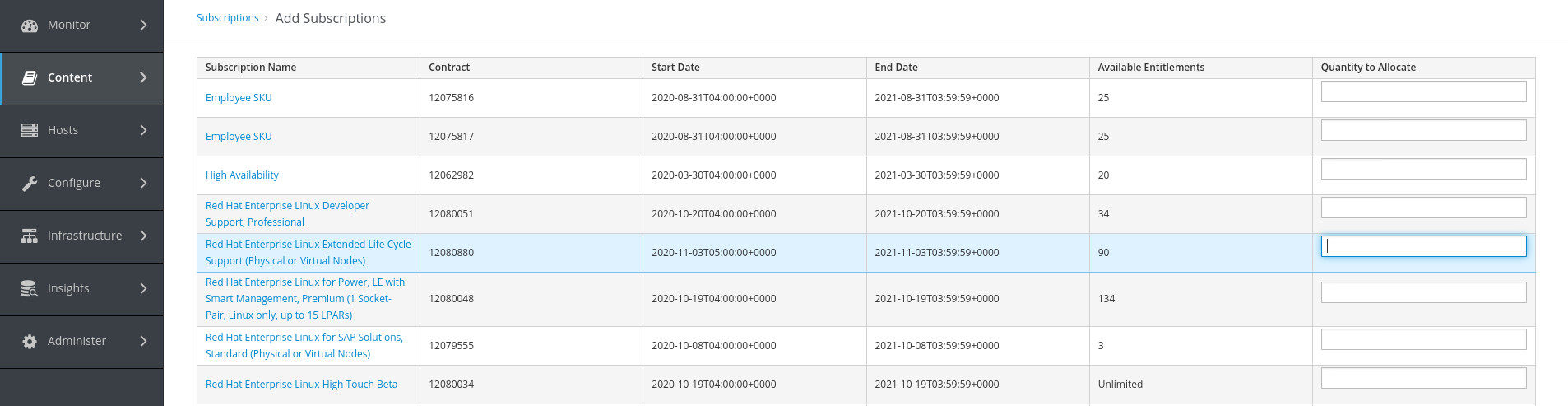
- Click Add Subscriptions
- Locate the Red Hat Enterprise Linux Extended Life Cycle Support subscription and edit the Quantity to Allocate to reflect the number of entitlements you wish to attach to your manifest
- Click Submit
Example (click to enlarge)
Attach a RHEL Extended Life Cycle Subscription to the Manifest via the Customer Portal
- Navigate to the This content is not included.Customer Portal - Subscription Allocations page
- Click the name of the Satellite Subscription Allocation (manifest) you wish to add ELS subscriptions to
- Click the Subscriptions tab
- Click the Add Subscriptions button
- Find the RHEL Extended Life Cycle Support subscription in the list, then change its Entitlement Quantity to the desired number of entitlements you wish to add to this allocation.
- Click Submit to save the entitlement quantity changes your manifest.
Finally, to synchronize the subscription allocation changes made in the Customer Portal to the Satellite 6 manifest, perform the following from within the Satellite's webUI:
- Navigate to the Content -> Red Hat Subscriptions page
- Click Manage Manifest
- Click Refresh Manifest
NOTE: If you already have the RHEL ELS subscription attached to your Satellite, a manifest refresh is still required to allow the subscription to obtain the new products and repositories on your Satellite. Please follow steps 7-9 above to refresh your manifest and continue with the steps below to enable and synchronize.
Synchronize RHEL 7 Extended Life Cycle Content to the Satellite 6 Server
Once the ELS subscription has been attached to the Satellite's subscription manifest, the repositories which provide access to this content must be *enabled* and then *synchronized*.
Enable the RHEL 7 Extended Life Cycle Repository
- Navigate to the Content -> Red Hat Repositories page
- To quickly locate the desired repositories, enter "Red Hat Enterprise Linux 7 Extended Life Cycle" into the text search box
- Click the repository name to expand architecture options, then click the + button next to the desired architecture to enable
Example (click to enlarge)
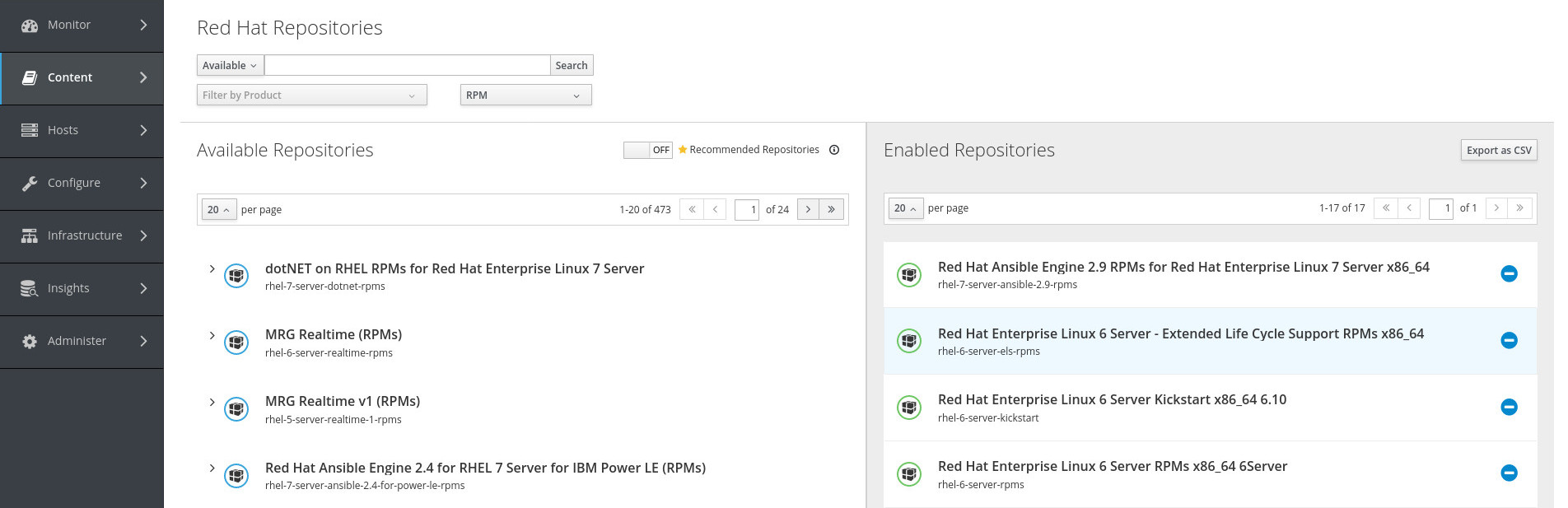
The repository is now enabled and ready to be synchronized.
Synchronize the RHEL 7 Extended Life Cycle repository
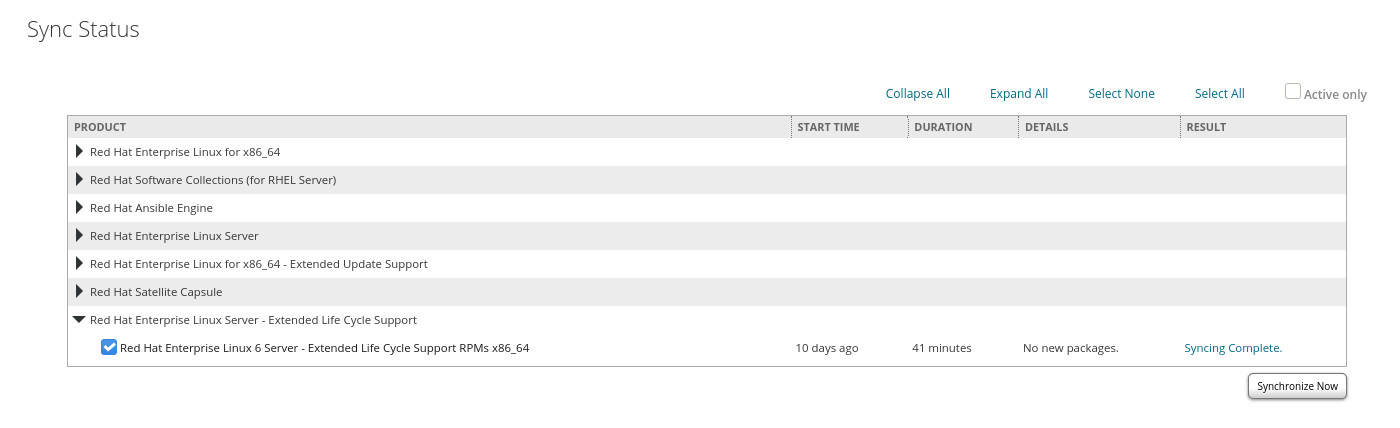
- Navigate to the Content -> Sync Status page
- Expand Red Hat Enterprise Linux - Extended Life Cycle Support -> Red Hat Enterprise Linux 7 Server - Extended Life Cycle Support (RPMs) -> 7Server -> select architecture
- Click the box next to the enabled repository
- Click Synchronize Now
Example (click to enlarge)
Once the repository has fully synchronized, additional steps are required to include this repository in a Content View to be presented to content hosts. Please refer to the Red Hat Satellite 6 Content Management Guide for further details.
Connecting Red Hat Enterprise Linux 7 systems to ELS content via Satellite 5
Satellite 5 reached End of Life on May 31, 2020 and is no longer a supported solution for accessing Red Hat content.
Enabling Red Hat Enterprise Linux 7 Extended Life Cycle content with Red Hat Update Infrastructure (RHUI)
*Note: Red Hat’s Certified Cloud & Service Provider (CCSP) Partners control what channels and packages are delivered through their service. See this Knowledgebase article for the most current information regarding what channels are available.
Add the RHEL 7 Extended Life Cycle Repository in RHUI
- From the
rhui-manageruser interface, execute^to navigate to the Red Hat Update Infrastructure Management Tool home screen - Enter
rto select manage repositories - Enter
ato add a new Red Hat content repository - Wait for the Red Hat Update Infrastructure Management Tool to determine the entitled repositories, this might take several minutes
- When the Red Hat Update Infrastructure Management Tool prompts for a selection method, press
2to select the By Product method - Enter the number listed beside the RHEL 7 Server - Extended Life Cycle Support RPMs repository
- Press
cwhen you are finished, followed byyto confirm - Check that the correct repository has been added by pressing
lto access the list of repositories currently managed by the RHUI screen
Synchronize the RHEL 7 Extended Life Cycle Repository in RHUI
- From the
rhui-manageruser interface, execute^to navigate to the Red Hat Update Infrastructure Management Tool home screen - Enter
sto select synchronization status and scheduling - Enter
srto select sync an individual repository immediately - Select the repository and press
cto confirm, followed byyto proceed - Enter
drto select display repo sync summary
Connecting Red Hat Enterprise Linux 7 Systems to ELS Content
Important: ELS subscription is an addon subscription that requires the attachment of an active RHEL Server subscription to be present on the system to utilize the RHEL 7 ELS content.
First, use the subscription-manager to have the client check for any subscription changes on its registration profile. If the subscription has been assigned to the registration profile on a Satellite or Customer Portal, this command will pull in the new assigned subscription(s) from the profile.
Note: The --force option is only required for older versions of RHEL 7 with older versions of subscription-manager. If you receive an error pertaining to the --force option, remove it from the command and run again without the option.
# subscription-manager refresh --force
OR
# subscription-manager refresh
Next, ensure that the system is using 7Server as its release version, as ELS content is only released for the 7Server
# subscription-manager release --set 7Server
Finally, enable the RHEL 7 Extended Life Cycle RPM repository and disable RHEL 7 RPM repository:
# subscription-manager repos --enable rhel-7-server-els-rpms
Repo 'rhel-7-server-els-rpms' is enabled for this system.

# subscription-manager repos --disable=rhel-7-server-rpms
Repository 'rhel-7-server-rpms' is disabled for this system.
Using RHEL 7 Container Images with Red Hat Enterprise Linux 7 Extended Life Cycle Repositories
Please refer to this KCS to see an example of building a custom RHEL 7 image using the RHEL 7 ELS repository.